Thursday, December 9, 2010

Module 3: The Invention of Hugo Cabret

SLIS 5420.002
Module 3
September 6-12


Summary:

Young Hugo lives behind the walls of a train station in France. What's he doing back there? He keeps the clocks on the correct time. Hidden away from everyone, Hugo also has a tendency to steal things that catch his eye. However, when he's spotted by a toymaker and his daughter (Hugo's age), his life starts to change. Suddenly, Hugo finds out that his secrets are not unique to him, but a part of something much larger! Citation: Selznick, B. (2007). The invention of Hugo Cabret. New York: Scholastic Press.


Citation:

Selznick, B. (2007). The Invention of Hugo Cabret. New York: Scholastic Press.


My impressions:

I thought this was a wonderful book. The use of text and pictures was masterful by Selznick. At several moments while I was reading did I feel like I was almost watching a movie. The illustrations did a wonderful job of contributing detail to the story that words might not have been able to describe. I would like to check out the audio book of this story from my library because the audio/dvd combination intrigues me. It would be interesting to see how the creators of the audiobook brought the storyline across.


Reviews:

From Booklist:
Gr. 5-8 Selznick's 'novel in words and pictures,' an intriguing mystery set in 1930s Paris about an orphan, a salvaged clockwork invention, and a celebrated filmmaker, resuscitates an anemic genre-- the illustrated novel--and takes it to a whole new level. The result is somewhat similar to a graphic novel, but experiencing its mix of silvery pencil drawings and narrative interludes is ultimately more akin to watching a silent film. Indeed, movies and the wonder they inspire, 'like seeing dreams in the middle of the day,' are central to the story, and Selznick expresses an obvious passion for cinema in ways both visual (successive pictures, set against black frames as if projected on a darkened screen, mimic slow zooms and dramatic cuts) and thematic (the convoluted plot involves director Georges Melies, particularly his fanciful 1902 masterpiece, 'A Trip to the Moon'.) This hybrid creation, which also includes movie stills and archival photographs, is surprising and often lovely, but the orphan's story is overshadowed by the book's artistic and historical concerns (the heady extent of which are revealed in concluding notes about Selznick's inspirations, from the Lumiere brothers to Franceois Truffaut). Nonetheless, bookmaking this ambitious demands and deserves attention-- which it will surely receive from children attracted by a novel in which a complex narrative is equally advanced by things both read and seen. (Reviewed January 1 & 15, 2007). Jennifer Mattson. 531pg. AMERICAN LIBRARY ASSOCIATION, c2007.

Matteson, J. (2007). [Book Review of The Invention of Hugo Cabret]. Booklist, 103(9/10), 97.

From School Library Journal:
Gr 4-9--With characteristic intelligence, exquisite images, and a breathtaking design, Selznick shatters conventions related to the art of bookmaking in this magical mystery set in 1930s Paris. He employs wordless sequential pictures and distinct pages of text to let the cinematic story unfold, and the artwork, rendered in pencil and bordered in black, contains elements of a flip book, a graphic novel, and film. It opens with a small square depicting a full moon centered on a black spread. As readers flip the pages, the image grows and the moon recedes. A boy on the run slips through a grate to take refuge inside the walls of a train station--home for this orphaned, apprentice clock keeper. As Hugo seeks to accomplish his mission, his life intersects with a cantankerous toyshop owner and a feisty girl who won't be ignored. Each character possesses secrets and something of great value to the other. With deft foreshadowing, sensitively wrought characters, and heart-pounding suspense, the author engineers the elements of his complex plot: speeding trains, clocks, footsteps, dreams, and movies--especially those by Georges Melies, the French pioneer of science-fiction cinema. Movie stills are cleverly interspersed. Selznick's art ranges from evocative, shadowy spreads of Parisian streets to penetrating character close-ups. Leaving much to ponder about loss, time, family, and the creative impulse, the book closes with a waning moon, a diminishing square, and informative credits. This is a masterful narrative that readers can literally manipulate.--Wendy Lukehart, Washington DC Public Library. 531pg. CAHNERS PUBLISHING, c2007.

Lukehart, W. (2007 March 1). The Book Review: Grades 5 & Up [Book review for The Invention of Hugo Cabret]. School Library Journal, 53(3), 218.


Library setting uses:

Since the illustrations are such an integral part of working with the plot of the story, it would be a fun idea to have a group of elementary students make a flip book that illustrates either a scene from the story or one they make up on their own. If the budget allows, it would be a great idea to use the book as a celebration of illustrators and Caldecott winners by getting an artist to donate their time to conduct the workshop.

Module 2: Are You There, God? It’s Me, Margaret

SLIS 5420.002
Module 2
August 30-September 5


Summary:

At the end of the summer before the start of her sixth grade year, Margaret and her family move from New York out to the suburbs of New Jersey. Although reluctant about the move at first, Margaret quickly makes friends of the local girls in her class and even joins their secret club. It is quickly apparant that Margaret is not like her new friends. She does not belong to a Christian church or to a Jewish synagogue. She has no official religion, but she does share a personal relationship with God where she often converses with him about things troubling her in life. Pulled back and forth between two religions until she can no longer take it, Margaret comes to her own conclusions concerning faith.


Citation:

Blume, J. (1970). Are you there God? It’s me, Margaret. New York: Atheneum Books for Young Readers


My impressions:

Growing up I had heard other girls talk about what a wonderful story this book creates. I never took the time to read a summary or even try to figure it out. But it intrigued me that almost every woman I've spoken to, who has grown up in the 80s and later, cites this book as a must-read and one of the best books they've ever read. Once I started it, let's just say, I finally got it. Impossible to put down, this book creates a wonderfully realistic character with Margaret and the struggle to identify herself in accordance with the demands of society and family. I have to admit, a part of me admires Margaret for sticking to her guns and for not choosing a religion simply based on pressure from others. I liked how she tried everything out herself and formed her own opinions. And as if all that wasn't enough, she's also a twelve-year-old who is becoming a woman and going through the beginning stages of adolescence!


Reviews:

From Kirkus Reviews:
The comical longings of little girls who want to be big girls -- exercising to the chant of "We must -- we must -- increase our bust!" -- and the wistful longing of Margaret, who talks comfortably to God, for a religion, come together as her anxiety to be normal, which is natural enough in sixth grade. And if that's what we want to tell kids, this is a fresh, unclinical case in point: Mrs. Blume (Iggie's House, 1969) has an easy way with words and some choice ones when the occasion arises. But there's danger in the preoccupation with the physical signs of puberty -- with growing into a Playboy centerfold, the goal here, though the one girl in the class who's on her way rues it; and with menstruating sooner rather than later -- calming Margaret, her mother says she was a late one, but the happy ending is the first drop of blood: the effect is to confirm common anxieties instead of allaying them. (And countertrends notwithstanding, much is made of that first bra, that first dab of lipstick.) More promising is Margaret's pursuit of religion: to decide for herself (earlier than her 'liberal' parents intended), she goes to temple with a grandmother, to church with a friend; but neither makes any sense to her -- "Twelve is very late to learn." Fortunately, after a disillusioning sectarian dispute, she resumes talking to God. . . to thank him for that telltale sign of womanhood. Which raises the last question: of a satirical stance in lieu of a perspective. (Kirkus Reviews, October 1, 1970)

Reviews. (1970, October 1). In Kirkus Reviews. Retrieved from http://www.kirkusreviews.com/book-reviews/fiction/judy-blume-10/are-you-there-god-its-me-margaret/


From School Library Journal:
Gr 4-7. Are You There God, It's Me, Margaret is Judy Blume's account of what it is like to be an almost 12-year-old girl whose greatest desire is just to be normal. The novel is honest and forthright. Margaret Simon worries that she doesn't have anything to fill her bra, that she will be the last girl in her group of friends to start menstruating, that she just won't fit in. And to compound things, she has no religion, so she can't join either the Jewish Community Center or the Protestant Youth Center in her new neighborhood. This recorded version of Margaret's conversations with God, her parents, friends and us, the audience, is even more authentic than the book. Laura Hamilton's reading captures Margaret's anxiety in her conversations with God, her indignation in some conversations with her parents, and her enthusiasm and vulnerability in conversations with her friends. She can emphasize the girls' fixation with the pronunciation of new words in their life, as well as Margaret's pain when she is forced to cancel her planned holiday visit to Florida to see her much loved grandmother. Listeners seem to be co-conspirators, sympathetic friends, and always important members of Margaret's entourage. This conversational story is well-served here. Edith Ching, St. Albans School, Washington, DC

Ching, E. (n.d.). “School Library Journal”. Retrieved from http://search.barnesandnoble.com/Are-You-There-God-Its-Me-Margaret/Judy-Blume/e/9780689841583/?itm=2&USRI=%22are+you+there+god%2c+it%27s+me+margaret%22


Library Setting Uses:

With a group of teens, perform the activity from Margaret’s first day at her new school: My name is. . .Please call me. . .I like. . .I hate. . .This year in school (at the library). . ..I think teachers (librarians) are. . . as an ice breaker at an after-school teen program. To add a twist to the activity, mix up some of the replies and have the students guess who wrote which reply in order to stimulate conversation and mingling.

Module 2: Madeline

SLIS 5420.002
Module 2
August 30-September 5


Summary:

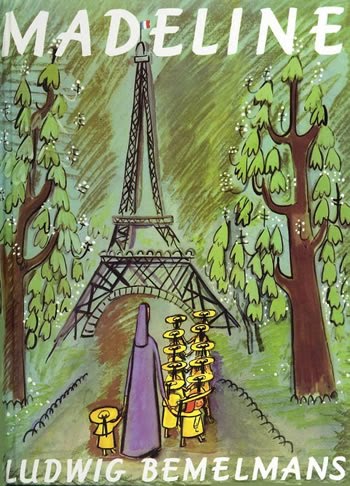
Madeline attends private school in Paris. She is the smallest of the twelve little girls who go to school under the supervision of the nun Ms. Clavel. Different from the other girls, Madeline is a bit of a tomboy and daredevil. However, one night, Ms. Clavel wakes and knows right away that something isn't right with one of the girls. Madeline is rushed to the hospital for an appendicitis. Upon her recovery, the little girls travel down to the hospital to visit her and decide that having surgery is worth it if they get to have presents delivered to them, too!


Citation:

Bemelmans, L.(1960). Madeline. New York: Viking Press.


My impressions:

Bemelmans captured the essence of little girls really well. I liked how he set up the characters in the book with the two rows of little girls traveling everywhere through Paris together before introducing the main character, Madeline. Madeline is the opposite of her classmates. She's the smallest, she's the most daring, and she's the least squeamish of all her classmates. Then, in the midst of the night, something happens to Madeline and throws the school out of sorts. The ending with all the little girls exclaiming that they, too, want their appendices out is the picture of childhood essence. I remember thinking how lucky classmates who had their tonsils out were because they got to eat ice cream a lot and how fun it must be to have a cast on your arm because everyone would want to sign it. I don't think most children reflect on the real reasons why their peers get special treatment when sick or injured.


Reviews:

From Kirkus Reviews:
Yes, it will sell:- (1) because it is Ludwig Bemelmans and a beautiful book; (2) because Bemelmans' sense of humor tickles the risibilities of adults and they buy books. Children may like the absurdities, but actually, the appeal is not juvenile. The charm of the pictures (other than the coloring itself) lies in the identification with familiar and recognizable objects. And the text is not keyed to the interests or understanding of the average child. (Kirkus Reviews, June 15, 1939)

Reviews. (1939, June 15). In Kirkus Reviews. Retrieved from http://www.kirkusreviews.com/book-reviews/childrens-books/ludwig-bemelmans-9/madeline/


From Barnesandnoble.com:
"In an old house in Paris that was covered with vines," lives plucky Madeline with eleven other girls under the care of the kind Miss Clavel. Madeline wakes up in the night with appendicitis and is rushed off to the hospital. The other girls visit Madeline after the operation, and see her gifts, her candy, and above all, her scar. That night they all cry, "Boohoo, we want to have our appendix out too!" Bemelman's drawings of Paris bring the charm of the city to young readers.

From Barnes & Noble. (n.d.). Retrieved from http://search.barnesandnoble.com/Madeline/Ludwig-Bemelmans/e/9780670445806/?itm=1&USRI=madeline+ludwig


Library Setting Uses:

After a reading of the book, either by an adult or children taking turns, children could make clothespin dolls to look like Madeline and her 11 other classmates. Using embroidery floss, markers, and construction paper (for the hats), this should be a good craft for “small fingers” to make the little girls all “in a row”. Or, if this craft is a little too difficult for the children, popsicle sticks can be used instead of clothespins.